Remitly Freelancer Wallet
Lead Product Designer · Remitly
Remitly built its business moving money from senders to recipients. For years, the recipient was the end of the story. This project asked what would happen if they weren't. Getting paid as a global freelancer is harder than it should be -- verification delays, platform fees, funds held without explanation. Remitly had a wallet product showing early signs of fit and a hypothesis worth testing: what if that foundation could serve the people on the receiving end, on their own terms? We had three months to validate it across three markets.
Year
2024–2025
Type
Product Design
Timeline
3 months, 0→1
Markets
Philippines, Mexico, Colombia
Team
Business Receive, Store of Value, Core Send
Outcome
We shipped Remitly's first business receive product, live in Mexico and Colombia on November 11, 2024, Philippines by December 15. Within 90 days, with no paid marketing: 4,500+ wallets activated across three markets, $500K+ in payment request volume, with the Philippines driving the majority of early traction.
Post-launch research surfaced the two most critical next steps: reduce friction for payers completing requests, and give freelancers a clear way to get their money out. Both were features I had already designed and advocated for before launch. The data ended up making the case for me.
My Role
Lead designer on a cross-functional team spanning business receive, store of value, and core send. I owned the three flows the product was built around: requesting payment, the payer experience, and the wallet offramp. That meant working directly with PMs, engineers context-switching from backend to frontend, compliance, and legal. And it meant making a case for the right design decisions – including a few that didn't make it into the first release.
Payment Request Flow
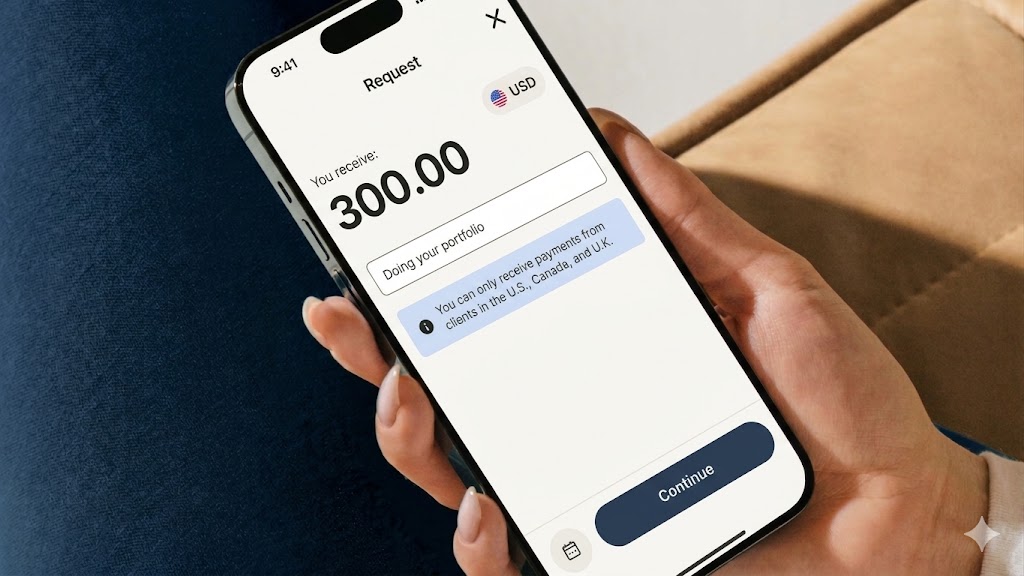
Sending money and requesting money are opposite mental models. A sender pushes funds to a known recipient; a requester pulls funds from a client who may not know Remitly exists. I cut the existing recipient infrastructure and built a clean payment link instead: amount, note, share. Right-sized for what a validation sprint needed to learn.
Payer Experience
A freelancer shares a link. Their client clicks it and needs to pay quickly. I designed a guest checkout: lightweight verification, Apple Pay or wire transfer, no account required. Nothing between a payment request and a completed transaction.
Wallet Offramp
A wallet without a clear way to get money out isn't really useful yet. I designed a purpose-built withdrawal flow and worked with research to validate the need. The finding went further: freelancers would hold more and stay longer if the wallet paid interest on idle balances. The offramp shipped as a fast follow. Interest on balances is on the roadmap.
Impact
0→1 in 3 months. From concept to market-ready across three countries, built on Remitly's existing platform.
4,500+ wallets, $500K+ in volume. Activated across Philippines, Mexico, and Colombia within 90 days of launch, with no paid marketing.
Anticipated what the data confirmed. Guest checkout and the offramp were deprioritized at launch. Both became the top two post-launch priorities once the data came in.
Foundation for P2P. The payment request infrastructure became the basis for Remitly's broader P2P capabilities across WhatsApp and KaiOS partnerships.
Recipients became customers. The product's premise was validated. The people on the receiving end of Remitly's network had financial needs worth building for. That bet is now a roadmap.